There’s something quietly countercultural about completely eschewing computer technology and existing in sole communion with one’s thoughts.
Yesterday, I took half a day off from work to sit for my Certification in Healthcare Revenue Integrity exam, my way of working toward more money-making potential in my career. For you see, o best beloveds, I largely agree with Lucius Annaeus Seneca, the great Roman Stoic, when he wrote his eighty-eighth letter to Lucilius and said:
De liberalibus studiis quid sentiam scire desideras: nullum suspicio, nullum in bonis numero quod ad aes exit. Meritoria artificia sunt, hactenus utilia si praeparant ingenium, no detinent. Tamdiu enim istis inmorandum est quandiu nihil animus agere maius potest; rudimenta sunt nostra, non opera.
You have been wishing to know my views with regard to liberal studies. My answer is this: I respect no study, and deem no study good, which results in money-making. Such studies are profit-bringing occupations, useful only in so far as they give the mind a preparation and do not engage it permanently. One should linger upon them only so long as the mind can occupy itself with nothing greater; they are our apprenticeship, not our real work.
Letter LXXXVIII (original, translation1)
To that end, when I leave the house and study in public, as I am doing in the vain hope that it will model good behavior for the younger set and for the curious who may deem such activities “cringe,” I withdraw from my study of business, instead seeking to deepen my knowledge of the world and those in it. There isn’t any shame in reading Descartes or Hardy in public, or at least I would hope there isn’t, and by showing people that this sort of thing is still interesting and relevant, my hope is that I’ll motivate others ot pick it up, too.
But what’s even better is when I keep my MacBook in my bag and sit down with just a CD player, a favorite CD, a book, a pen, and a notebook. The book is currently a volume of Descartes of the sort familiar to any philosophy student (a cheap paperback printed by Hackett Publishers – I doubt I gave much more than $5 for it from ThriftBooks), containing two rather lively translations of the Discourse on the Method and the Meditations on First Philosophy. When I am reading critically like this, I do find it helpful to engage with a translation first even if I speak the language of the work, as is the case with Descartes and the French2 in which the Discourse is written. The ideas stand a better chance of hitting my brain and staying there if I read them in English, and if you think this shameful, then that is certainly one of the opinions of all time.
Yesterday, at the library, I found myself drawing a blank at the meaning of the word diffidence, and it would have been easier to stay sitting at the table where I was studying and pull out my iPhone to define the term. I didn’t want to do that, though. I wanted to keep myself away from using my iPhone to do anything other than pulling up another album to listen to on Apple Music Classical (upcoming post on that – it is the best part of having an Apple Music subscription), so I got my ass up from my seat, pretended it was 1996, and got the unabridged dictionary from the stacks. Turns out, it’s shyness stemming from a lack of self-confidence, an emotion with which I am altogether too familiar as a lifetime charter member of the Collective of Shy Men, an organization I totally did not3 just pull out of my own ass for this blog post.
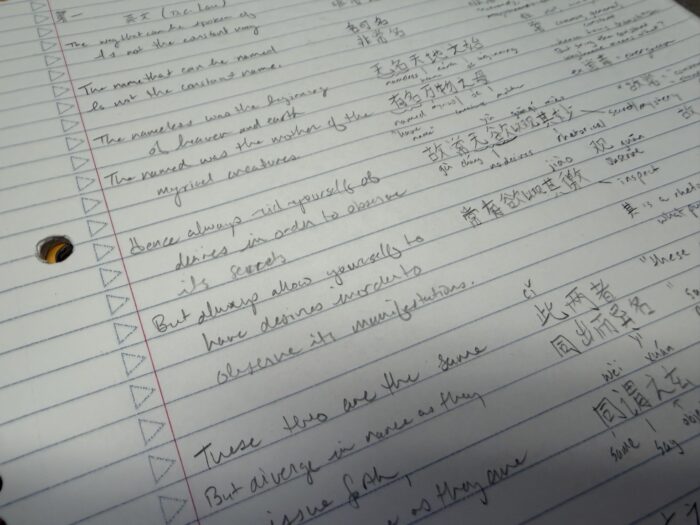
Perhaps it’s because I grew up in an age where writing on paper was just the done thing, but I find it most intuitive to write things down on paper despite having a tremendous affection for my iPad and Apple Pencil. When I am working with translation and poetry analysis, as you see above, I find it easiest to write out the original and the translation. In the above, I was working with D.C. Lau’s translation of the first chapter of the Daodejing, which I used as an excuse to learn a few new hanzi and a tiny portion of literary Chinese. I find the Daodejing easier to understand as a work of philosophy by examining the source text and the translation simultaneously because in Classical Chinese, the rhetorical style is extremely restrained by Western standards and as such, many texts admit multiple possible interpretations in quantum superposition.
I’m also keeping a commonplace notebook organized by work, in which I write down particularly effecting passages from works I’m reading. I wrote down several dozen such passages from the Meditations of Marcus Aurelius when I read that one last month and earlier this month. The whole point is to engage in activities that keep my hands away from my phone (and, for that matter, that keep my eyes away from a Web browser). Writing things out longhand increases my recall since I must read it from the source text, analyze it in my mind, and only then may I start noting it down in my notebooks. I’m doing this with everything of substance that I read and want to have any recall of, and as of this very moment, I am currently doing it with the great (and long) essay “The World and the Jug” by Ralph Ellison as well as Descartes.
Side note: the matcha latte at Starbucks, which is my new favorite thing from their menu (yes, even usurping a good old fashioned cup of black Pike Place), is significantly better if you order it without syrup. I ordered one at the Starbucks near work and they left the syrup out in error, and I liked the drink so much as a result that I now order it this way. I’m reminded of the story my dad tells of how he learned to eat rare steak: he was on a construction job and was absolutely starving. As such, he hopped in his truck and drove to the first restaurant he could find near his worksite. The cook messed up his steak order, cooking it to medium rare instead of his customary well-done. He was too hungry to send it back, so he cut into it and despite his revulsion, ate it – only to figure out that that is the way God meant4 a steak to be ordered. If the restaurant messes up your order, don’t necessarily put it down to malice. It may just be serendipity.
You know the drill: feed your mind, mind your feeds, look both ways before trusting an opinion, call your mom, and be sure to practice your Spanish and wash your butt (upcoming post: mí y la lengua española).
Footnotes
- I can read enough Latin to see that the (uncredited) translator took some liberties with the text. Learn yourselves some Latin, readers. It may not ever save your life, but it’ll definitely make your life easier as a scholar of the classics. ↩︎
- Nota aux francophones : Si vous voudriez lire le Discours en français, il y a une bonne édition disponible ici au Cégep Trois-Rivières au Québec. Cette version a des orthographies modernisées pour faciliter la lecture chez les francophones qui ne sont pas nés au 17e siècle. 🙂 ↩︎
- Y’all ought to know me better than that by now. ↩︎
- The Creator clearly meant for steaks to be rare, not medium rare. Rare is the only way I will order a steak when I am in a restaurant, and it is the only way I will cook a steak for my own consumption in my kitchen. I feel the same way about lamb. ↩︎